
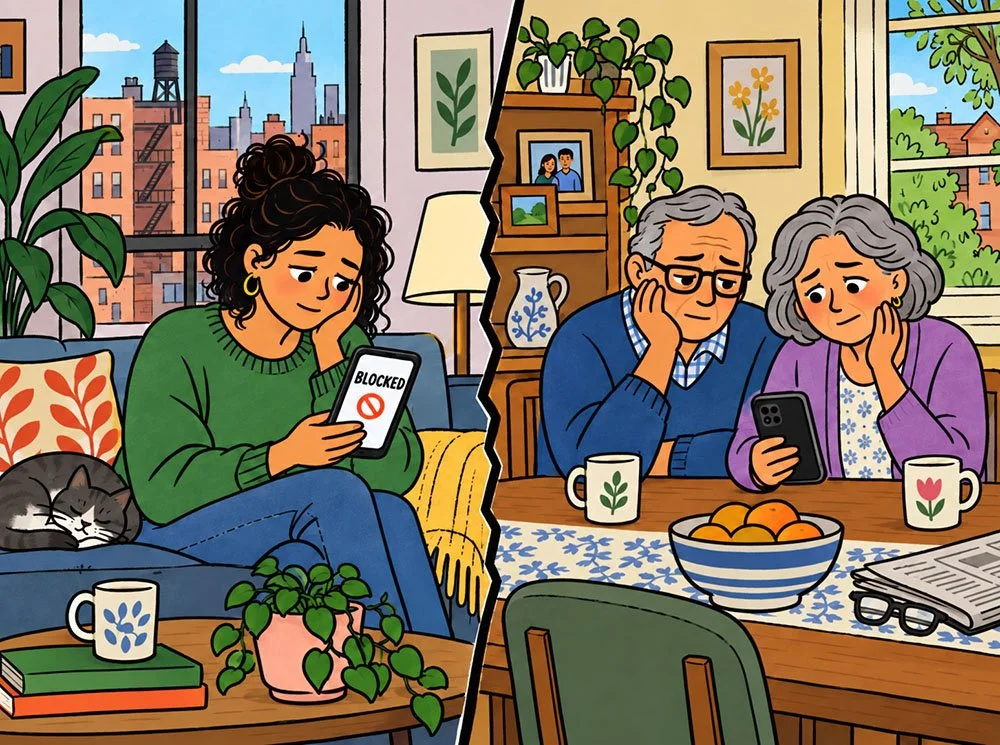
Beyond “No Contact”: Growth, Boundaries, and Coming to Terms With Family
In recent years, there has been increasing discussion online and in clinical spaces about cutting off “toxic” family members and “going no contact.” For many people, this idea grows out of a very real need to stop enabling abusive, chaotic, or addictive behavior that has become emotionally unbearable.
In some situations, creating significant distance is necessary and protective. At the same time, as a therapist, I’m cautious about how quickly “no contact” is often framed as the primary or only path to healing. When applied rigidly, it can sometimes bypass the deeper work of understanding and emotional growth that comes from working through a challenging relationship.
What Distance Protects and What It Avoids
There is an important difference between setting limits and emotionally cutting off. Stepping back from someone who is actively harmful or unsafe can be an act of self-preservation. But a set in stone cutoff can also function as a way to avoid unresolved pain and difficult family history.
When we remove someone from our lives without exploring how they shaped us, their influence rarely disappears. Instead, it inevitably shows up indirectly in our relationships, our emotional reactions, and the roles we continue to play without realizing why.
The Work Is Not About Reconciliation
Therapy is not about forcing forgiveness or maintaining family relationships at all costs. The goal is not reconciliation, and it’s certainly not about excusing harm. Rather, it’s about helping people come to terms with family members who have mistreated or failed them so those experiences no longer quietly organize their lives.
You may never change an unhealthy family member. You may never have the relationship you hoped for. But by identifying the ways you were harmed, misunderstood, or burdened, you gain the ability to separate the past from the present and to choose differently going forward.
Unresolved Family Dynamics Live On
Family patterns don’t end simply because contact ends. Without awareness, they tend to repeat themselves in new forms. People often find that the same dynamics, whether they be caretaking, avoidance, self-silencing, or emotional volatility, reappear in romantic relationships, friendships, or professional settings.
This isn’t a failure of willpower. It’s the nervous system doing what it learned to do early on. Healing requires understanding those patterns, not just stepping away from their original source.
Boundaries are the Key to a Middle Ground
For many people, growth lies not in severing ties but in learning how to remain in relationship without continuing to absorb harm. Boundaries allow for this middle path. They make it possible to redefine contact in ways that protect your emotional well-being while preserving what may be meaningful or functional.
This might mean engaging differently, limiting certain conversations, or letting go of the role you once played to keep others stable. Boundaries are not punishments; they are acts of self-respect. And they often feel deeply uncomfortable at first, especially if your family benefited from you having none.
Tolerating Complexity Instead of Choosing Sides
Family relationships are rarely simple. Someone can be loving and damaging at the same time. They can have offered real care while also causing lasting harm. Growth often involves holding this complexity without needing to change it into all-good or all-bad narratives.
Grieving what you didn’t receive while acknowledging what you did can be painful, but it’s also emotionally mature. It allows you to move forward without erasing parts of your story or yourself.
Ending Cycles of Harm Starts With Self-Awareness
Lasting change doesn’t come from cutting people out and going it alone. It comes from understanding how your past shaped your present and developing new tools where old ones failed you. This includes learning how to regulate emotion, tolerate conflict, name your needs, and choose relationships that don’t replicate familiar harm.
This is how cycles actually end. Not through avoidance, but through conscious, supported change.
A More Sustainable Kind of Freedom
“No contact” may be the right choice for some people at certain moments in their lives. But it isn’t the only form of healing, and it isn’t always the deepest one.
Learning to come to terms with your family history, set thoughtful limits, and understand how those early relationships shaped you can create a more durable sense of freedom, and one that doesn’t rely on emotional exile to feel safe.
You are allowed to protect yourself and grow.
You are allowed to change even if your family doesn’t.
And you are allowed to build a life no longer organized around past harm.
If you’re navigating complicated family relationships and want support in finding a path that feels both safe and emotionally honest, therapy can help you do that work at your own pace.
Related Articles
If this topic resonates with you, you may also find these articles helpful: