
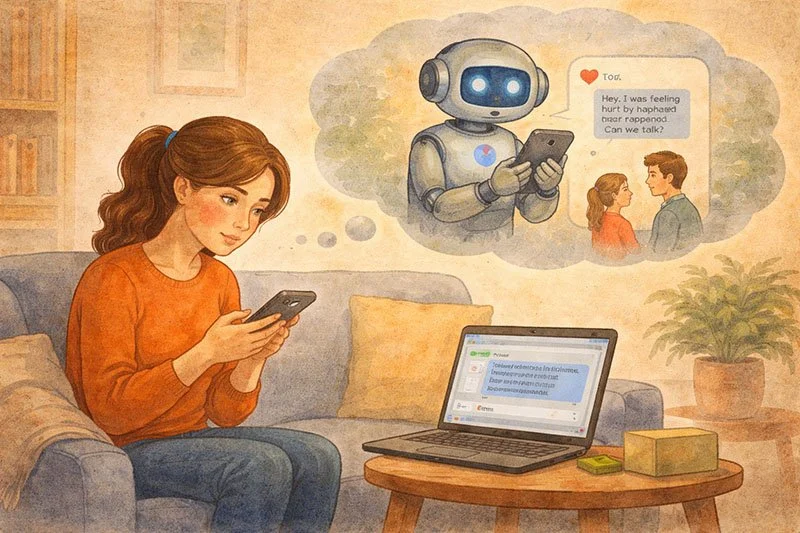
When AI Becomes Our Emotional Middleman
Just yesterday, a client described how ChatGPT helped her figure out what to say to her Ex during a difficult conversation. This is becoming quite common to hear and I’ve used AI myself to draft a careful text or email and soften the language, or avoid escalating tension.
There is nothing inherently wrong with that and certainly AI is only becoming more pervasive and astute. Used thoughtfully, AI can be a genuinely helpful productivity tool. But there’s an emerging line that, as a mental health provider, I think is worth paying attention to. So where is the line between support and emotional outsourcing?
Productivity Tool or Emotional Crutch?
AI excels at structure, clarity, and efficiency. It can help organize thoughts, rehearse language, or reduce overwhelm when emotions run high. For many people, that feels like relief. The problem arises when we start to depend on AI to do something much more intimate: managing our emotional discomfort for us.
When we rely on AI to soothe anxiety, script vulnerability, or navigate tension in a personal relationship, we may be skipping the important step of actually tolerating and working through those feelings ourselves.
What We Lose When We Offload Emotional Work
An Op-Ed in The New York Times recently captured this concern succinctly:
“Just as overreliance on calculators can weaken our arithmetic abilities and overreliance on GPS can weaken our sense of direction, overreliance on A.I. may weaken our ability to deal with the give and take of ordinary human interaction.”
Human relationships are messy by design. They require hesitation, missteps, repair, and emotional risk. These experiences build resilience, self-trust, frustration tolerance, problem-solving and relational confidence. When a tool smooths every edge, we lose opportunities to develop those muscles.
Discomfort Is Not a Bug — It’s the Work
In therapy, we often focus on helping people stay present with uncomfortable emotions rather than immediately escaping them. When our coping mechanisms are built primarily around escape, they can quietly erode our sense of agency.
Instead of helping us process discomfort, these habits encourage withdrawal and avoidance. Over time, what begins as relief can slide into passivity, increased isolation, and patterns of behavior that ultimately keep us stuck rather than supported.
It’s good to learn to cope with the anxiety before sending a difficult text, or the uncertainty about how something will land, and the vulnerability of saying what we actually feel to people we care about.
These moments are not inefficiencies to eliminate. They are how we learn who we are in relationship with others; they increase our self-awareness and improve the quality of our personal lives.
A Healthier Boundary With AI
This isn’t about rejecting AI altogether. It’s about intention. AI can be useful for clarifying thought and saving time on logistical tasks. It might help with drafting an email to a co-worker to make it more succinct or professional.
But it is worth pausing when we start using it for:
Emotional reassurance
Avoiding difficult conversations
Replacing internal reflection
A helpful question to ask ourselves is:
Is this helping me engage more fully with my life or helping me avoid it?
A Gentle Invitation
If you find yourself relying on AI to manage emotional conversations, soothe anxiety, or avoid difficult interactions, it can help to think of it as a useful signal. What is it about this conversation or interaction that makes me feel anxious or uncomfortable?
These are often the very moments where support from a real human relationship can make a difference.
Therapy offers a space to slow down, reflect, and build the emotional skills that no tool can automate. If you’re curious about strengthening your ability to navigate relationships with more confidence and authenticity, I invite you to reach out and begin that work together.
Related Blog Article: How Social Media Warps Self-Esteem; Anxiety: Change the State, Not Yourself